
15 AI Tools Digital Marketing Experts Should Know in 2026
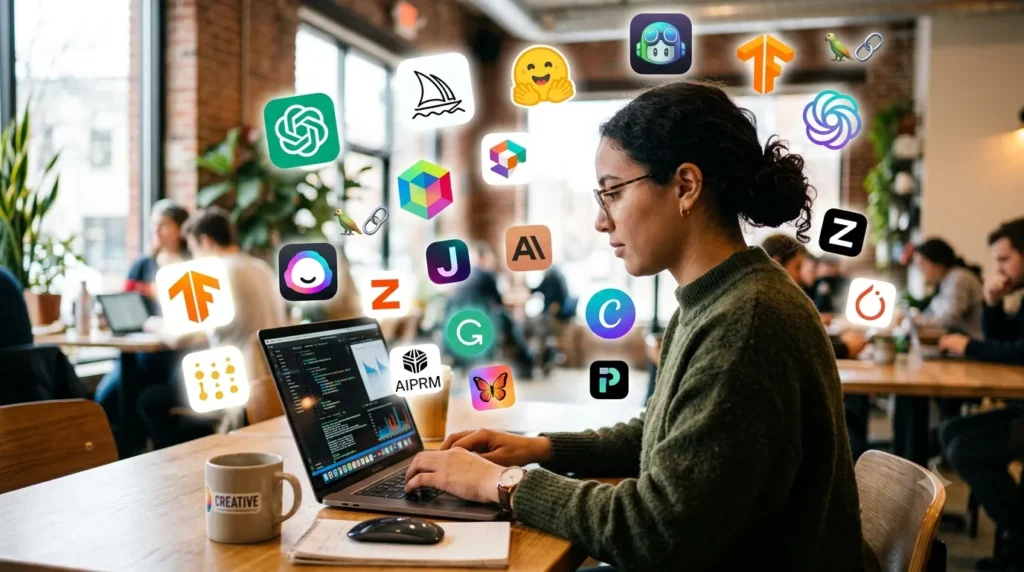
The best AI tools digital marketing teams use in 2026 handle drafting, research, design, email, and reporting, so people can spend their time on strategy. This guide covers 15 AI marketing tools, what each one does, and who should use it. Every tool is grouped by job, so you can find the right one quickly.
If you want help turning these tools into a working plan, a digital marketing expert can map them to your goals and budget.
What are AI tools for digital marketing?
AI tools for digital marketing are software products that use machine learning or generative AI to speed up marketing tasks. They write copy, analyze data, create images, schedule posts, and run marketing automation.
They fall into five groups: content and research, SEO, design and video, email and automation, and analytics and ads. Most teams need one or two tools from each group, not all fifteen.
Best AI tools digital marketing teams use for content and research
This group covers the tools you open first thing in the morning. They handle AI content creation, research, and first drafts.
1. ChatGPT
ChatGPT is a general-purpose AI assistant from OpenAI. Marketers use it for AI content creation tasks like outlines, ad variations, email subject lines, and campaign brainstorming. It works best when you give it a clear brief and your brand voice.
Best for: fast drafts, ideation, and repurposing content.
2. Claude
Claude is an AI assistant from Anthropic. It handles long documents well, so it suits summarizing research, rewriting long-form content, and analyzing customer feedback. Many marketers use it for careful editing as well as drafting.
Best for: long-form writing, editing, and document analysis.
3. Perplexity
Perplexity is an AI answer engine that shows the sources behind its responses. That makes it useful for competitor research, market sizing, and fact-checking before you publish. Always open the cited sources yourself.
Best for: research with traceable sources.
4. Jasper
Jasper is built for marketing teams. It stores brand voice and style rules, then applies them to blog posts, ads, and social copy. It fits teams that scale AI content creation and need consistent tone across writers.
Best for: brand-consistent copy at volume.
AI tools for SEO that improve rankings
SEO is where AI tools digital marketing specialists adopt earliest, because search work involves large amounts of data. These AI SEO tools cover research and on-page optimization.
5. Semrush
Semrush is an SEO platform for keyword research, competitor analysis, site audits, and rank tracking. Its AI features help with content ideas and tracking how your brand appears in AI-driven search. It suits marketers who run search-led strategies.
Best for: keyword research and competitor analysis.
6. Surfer SEO
Surfer SEO compares your draft with pages that already rank and suggests terms, headings, and structure. It is a practical editor for on-page work. Use its suggestions as guidance, not as a checklist to copy.
Best for: on-page content optimization.
AI tools for design and video
Visual work used to need a designer for every small change. These tools let marketers produce good assets alone, and a designer can then refine the best ones.
7. Canva
Canva includes AI features for generating images, resizing designs, and editing photos. Brand kits keep fonts and colors consistent across social posts, presentations, and ads. It is the easiest design tool for small teams.
Best for: social graphics and quick creatives.
8. Midjourney
Midjourney generates original images from text prompts. Marketers use it for campaign concepts, mood boards, and unique visuals that stock libraries lack. Check the usage terms before using its images in paid campaigns.
Best for: custom concept art and campaign visuals.
9. Descript
Descript lets you edit video and audio by editing the transcript. Delete a sentence in the text and it disappears from the recording. That saves hours on podcasts, webinars, and short social videos.
Best for: editing video and audio quickly.
AI marketing tools for email, social, and automation
Personalization and timing decide whether a message gets read. These tools use generative AI and customer data to send the right message at the right moment. A digital marketing expert can set up these workflows so they run without constant supervision.
10. HubSpot
HubSpot combines a CRM with marketing, sales, and service tools. Its AI assistant helps write emails, summarize contact records, and build content. It suits teams that want one platform for marketing automation and the whole customer journey.
Best for: all-in-one CRM and inbound marketing.
11. Klaviyo
Klaviyo specializes in email and SMS for ecommerce brands. It uses shopper behavior to segment audiences and trigger messages such as abandoned cart reminders. Online stores get the most from it.
Best for: ecommerce email and SMS personalization.
12. Buffer
Buffer schedules posts across social platforms and includes an AI assistant that drafts and rewrites captions. Its simple interface suits solo marketers and small businesses that want consistency without a heavy tool.
Best for: simple social media scheduling.
13. Zapier
Zapier connects thousands of apps and automates the handoffs between them. A new lead in a form can create a CRM record, send a welcome email, and notify your team. Its AI features let you describe a marketing automation workflow in plain language.
Best for: connecting tools and removing manual tasks.
AI tools digital marketing analysts use for data and ads
Reporting is where AI saves the most time, and predictive analytics gives you a head start on trends. These tools turn raw numbers into predictive analytics and automated campaign decisions.
14. Google Analytics 4
Google Analytics 4 tracks website and app behavior. It includes machine learning features such as predictive analytics and anomaly detection, which flag unusual traffic changes. It is free, which makes it a sensible starting point.
Best for: free analytics and predictive audiences.
15. Google Ads Performance Max
Performance Max is a Google Ads campaign type that uses automation to place your ads across Google’s channels. You supply assets, goals, and audience signals, and the system tests combinations. It rewards strong creative and clear conversion tracking, and its predictive analytics improve with more data.
Best for: automated paid campaigns.
Quick comparison of the 15 tools
Tool | Main job | Best for |
|---|---|---|
ChatGPT | Drafting and ideas | Fast first drafts |
Claude | Writing and analysis | Long documents |
Perplexity | Research | Sourced answers |
Jasper | Brand copy | Teams at scale |
Semrush | SEO research | Keywords and competitors |
Surfer SEO | On-page SEO | Content scoring |
Canva | Design | Social graphics |
Midjourney | Image generation | Concept visuals |
Descript | Video editing | Webinars and clips |
HubSpot | CRM and marketing | Full-funnel teams |
Klaviyo | Email and SMS | Online stores |
Buffer | Social scheduling | Small teams |
Zapier | Automation | Connecting apps |
Google Analytics 4 | Analytics | Free reporting |
Performance Max | Paid ads | Automated campaigns |
How to choose AI tools digital marketing budgets can support
Start with one problem, not one tool. If drafting takes too long, begin with a writing assistant. If reporting eats your Fridays, begin with analytics and automation.
Check four things before you pay:
- Does it connect with the tools you already use?
- Can you try it on a free plan or trial first?
- Does it keep your customer data private?
- Will your team use it every week?
Free AI tools for digital marketing, such as Google Analytics 4 and the free plans of Canva and Buffer, are enough for a small business to start. Add paid tools only after you see a clear time saving or revenue gain.
Mistakes to avoid when using AI marketing tools
Publishing raw AI output is the most common mistake. Google’s guidance on generative AI content says the focus is on whether content is helpful and original, not on how it was made, so edit every draft for accuracy and add your own experience. You can read the details in Google’s guidance on AI-generated content.
Other mistakes include buying too many tools at once, skipping a fact-check on statistics, and feeding private customer data into tools that have not been vetted. Treat AI as a fast assistant. A human still owns the strategy and the final edit.
Key takeaways
- AI tools digital marketing teams use fall into five jobs: content, SEO, design, email and automation, and analytics.
- Start with one tool for your biggest time drain, then add more.
- Always fact-check and edit AI output before publishing.
- Free plans are enough to test most tools.
- Strategy, brand voice, and judgment stay with people.
Frequently asked questions
What are the best AI tools for digital marketing in 2026?
The most widely used picks include ChatGPT, Claude, Semrush, Surfer SEO, Canva, HubSpot, Klaviyo, and Google Analytics 4. The best choice depends on your channel mix, team size, and budget.
Are there free AI tools for digital marketing?
Yes. Google Analytics 4 is free, and Canva, Buffer, and several AI assistants offer free plans with limits. They are enough for testing before you commit to paid subscriptions.
Can AI tools replace digital marketers?
No. AI tools handle repetitive work such as drafting, scheduling, and reporting. Positioning, creative direction, and client relationships still need people. Marketers who use AI well tend to produce more in the same time.
How many AI tools does a marketing team need?
Most teams do well with three to five tools: one for writing, one for SEO, one for design, and one for automation or analytics. More tools add cost and training time.
Are AI tools good for SEO?
They help with keyword research, content outlines, and on-page optimization. Rankings still depend on useful, accurate content, so use AI SEO tools to support your work, not to replace editing.
Conclusion
The right AI tools digital marketing professionals choose in 2026 are the ones that fit their workflow and save real hours. Pick one tool from the group that matches your biggest bottleneck, test it for a month, and measure the result before adding another.
If you want a tailored stack and a plan to use it, talk to a digital marketing expert who can match the right tools to your business goals.